Apparel
Tights Denier Explained: What 10, 20, 40, 60 and 80 Actually Mean
What denier means on tights packaging: how 10, 20, 40, 60 and 80 differ in sheerness, which weights suit which season, and how the nylon-elastane blend drives durability.
Clothing, shoes & accessories, honestly reviewed
Apparel
What denier means on tights packaging: how 10, 20, 40, 60 and 80 differ in sheerness, which weights suit which season, and how the nylon-elastane blend drives durability.
By Claire Whitmore · Fashion Editor
Last updated September 29, 2026
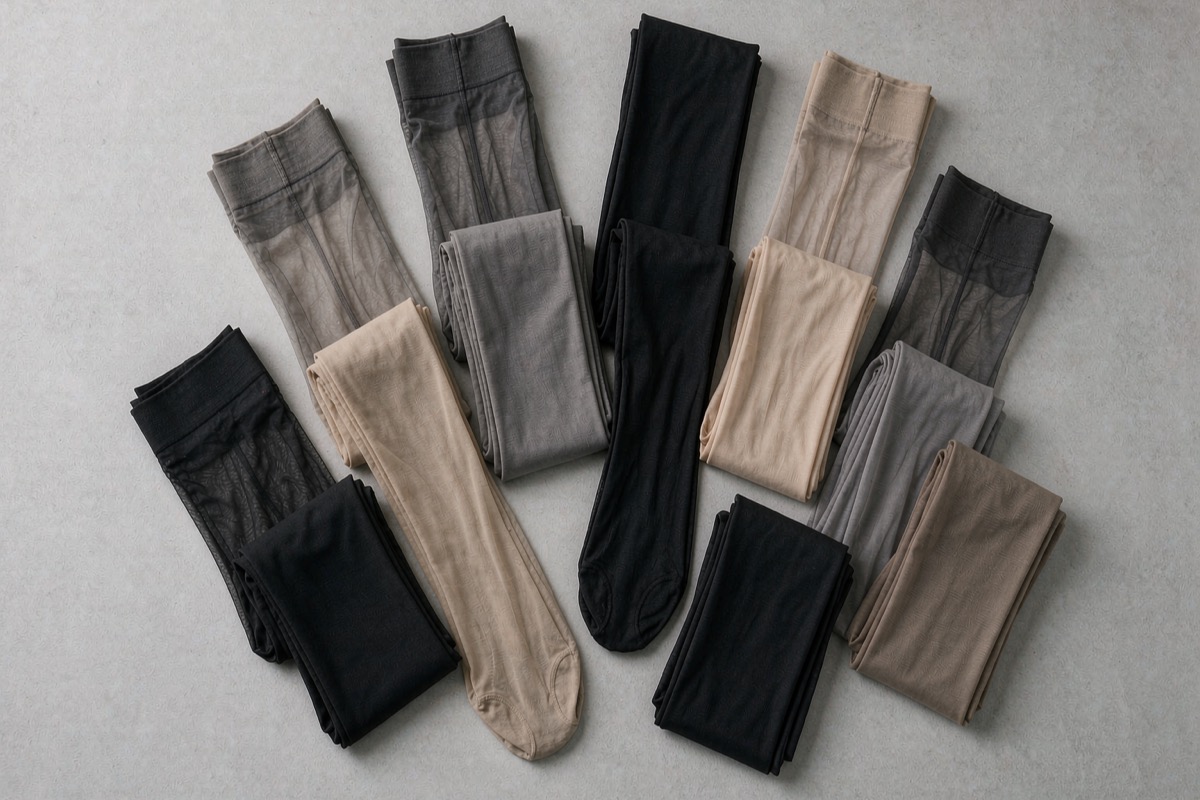
The number printed on a pair of tights is one of the few garment specs a shopper can verify without a lab, and it does more work than any copy on the packaging. Denier is a unit of weight: the mass in grams of 9,000 meters of yarn. Lower numbers mean finer, lighter yarn, which reads as sheer; higher numbers mean thicker yarn, which reads as opaque. That single figure predicts how sheer the leg looks, how warm the fabric feels, and roughly how long the pair survives.
Ultra-sheer hosiery lives at 10 to 20 denier. At 10, the weave nearly disappears against skin, which is why it belongs with evening and formal dressing. Twenty denier is the classic everyday sheer: still translucent, with just enough body to survive a commute. The trade-off is structural — a 10-denier yarn is fine as silk thread, and one snag can run the length of the leg, so the finest weights behave as occasional-wear pieces rather than weekly ones.
Around 40 denier, the fabric stops reading as glass and starts reading as fabric. Semi-opaque tights mute the skin tone without hiding it, which looks polished with skirts and dresses while smoothing minor unevenness. At 60, the leg reads solid, and 80 approaches the weight of thin leggings with a matte finish that sits well under boots. Past roughly 100 denier, hosiery shades into legwear designed for warmth first and appearance second.
| Denier | How it reads | Best for |
|---|---|---|
| 10-20 | Ultra sheer | Evening, formal, warm days |
| 30-40 | Semi sheer | Office, shoulder seasons |
| 60-80 | Opaque | Cold months, daily wear |
| 100+ | Heavyweight | Deep winter, boot layering |
The calendar mapping is simple. Sheer 10 to 20 denier belongs to late spring through early fall, when the point of hosiery is polish rather than insulation. Thirty to 40 covers the shoulder seasons and air-conditioned offices, and it is the most versatile single pair in a drawer. Sixty and up is cold-weather territory, and many women layer 20 denier over 60 in deep winter for a tinted, insulated effect.
Nearly every pair on the rack is nylon with a share of elastane, and the ratio matters as much as the denier. Nylon supplies the strength; it is the fiber family DuPont introduced in the late 1930s, and it resists abrasion better than natural fibers of the same weight. Elastane, developed at DuPont in 1958, supplies stretch and recovery — the reason tights stay at the waist and return at the knee. Most tights run 10 to 20 percent elastane; a higher share means better shape retention, while a 100 percent nylon pair, still sold in vintage-style sheers, tends to bag at the knee by afternoon. Denier governs run resistance — thicker yarns tear less easily — but a heavy weave with poor recovery fails a different way, sagging rather than tearing.
One care note extends the life of any denier: heat degrades elastane, so a cool wash and flat drying preserve the recovery that makes a pair wearable.
Denier is simply the weight-and-sheerness dial, and the blend is the durability dial; read both before buying. The fabric guide to clothes that last explains how construction predicts lifespan across fabrics, and the linen versus cotton comparison applies similar weight-based logic to warm-weather cloth. For the heavier, opaque end of the range, see the guide to best black leggings, and more apparel explainers live in the apparel section.
Thirty to 40 denier is the most versatile office weight: sheer enough to read refined, sturdy enough for a daily commute. Ten to 20 suits formal evening events, while 60 and above reads more casual and seasonal.
Generally yes. Thicker yarns trap more air and block more wind, so 60 to 80 denier suits cold months while 10 to 20 works in warm weather. Fleece-lined or thermal versions add warmth beyond what the denier figure alone indicates.
The yarn is extremely fine, so a small snag or rough nail breaks it and the run travels down the leg. Choosing a higher elastane share, keeping nails smooth, and washing in a mesh bag all reduce the risk.
Claire Whitmore · Updated September 20, 2026
Claire Whitmore · Updated September 20, 2026
Claire Whitmore · Updated September 19, 2026
Claire Whitmore · Updated September 19, 2026