Guides
Drawer Folding Methods: File Folding So a Drawer Shows You Everything
Why horizontal stacks fail, how file folding works step by step for tees, knits and jeans, and the drawer setup that keeps the fold intact on a rushed morning.
Clothing, shoes & accessories, honestly reviewed
Guides
Why horizontal stacks fail, how file folding works step by step for tees, knits and jeans, and the drawer setup that keeps the fold intact on a rushed morning.
By Claire Whitmore · Fashion Editor
Last updated October 10, 2026
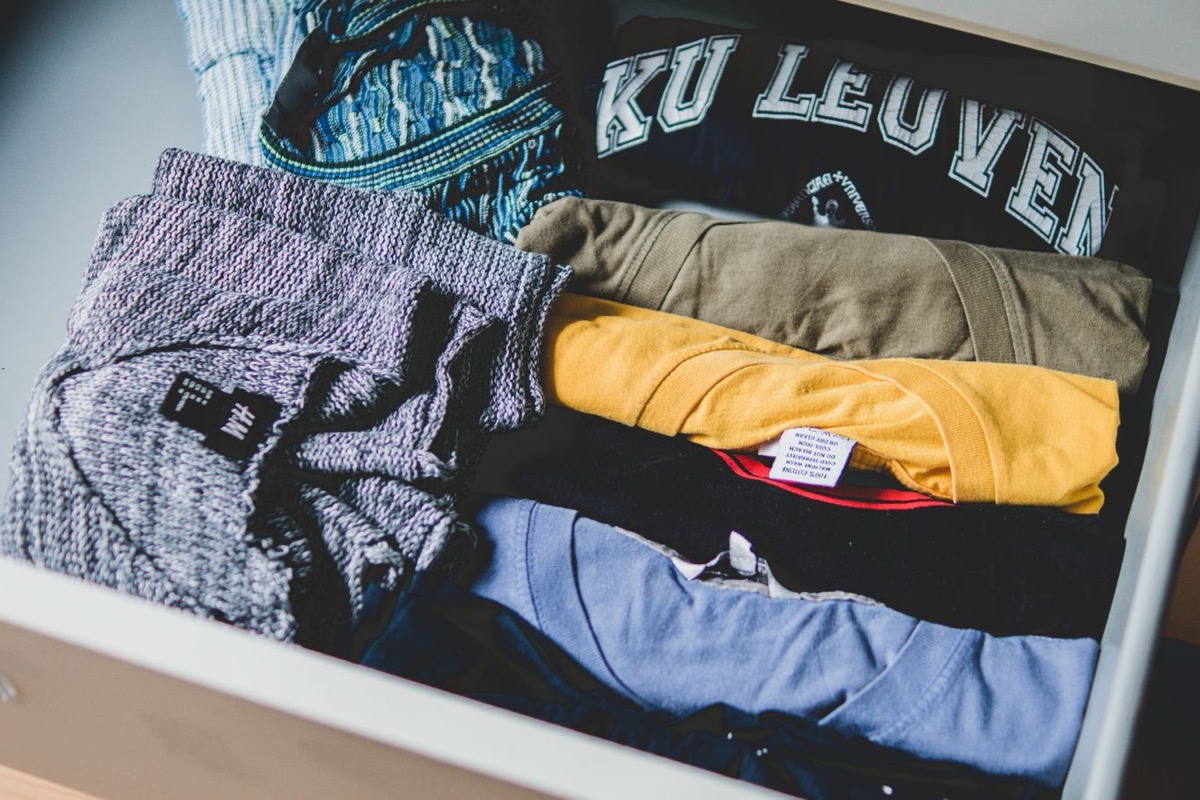
Every folded drawer starts the same way and fails the same way. You fold a stack of six t-shirts, flat, one on top of another, the way the shop did it. On day one it looks like a store display. On day three you need the third shirt from the bottom, and the only way to get it is to lift the whole tower — which tips, slides, or lands on the bed as a wrinkled pile. By month three the drawer contains one shabby compression block and a loose sediment of shirts you stopped refolding because why bother.
The problem was never your folding. It was the architecture. A horizontal stack gives you access to exactly one garment — the top one — and charges you a full restack for anything below it. That cost is why the stack dies. Nobody restacks at 7 a.m.
The repair is to turn the stack ninety degrees. Fold each garment into a rectangle that can stand on its edge, then file it upright in the drawer, like folders in a drawer of a filing cabinet — which is where the name comes from. Marie Kondo popularized the version most people know, but dry cleaners and hotel linen rooms have filed fabric vertically for decades; the idea is older than the book.
The payoffs are physical, not aesthetic. Every garment is visible from above — you see the whole drawer’s inventory in one glance, which is most of the reason a filed drawer gets worn more evenly. And every garment comes out singly. Pull the third shirt and the other five do not move. The restack cost drops to zero, which is what keeps the system alive past week two.
T-shirts and light cotton. Lay the tee face down, fold both sleeves in to make a rectangle, then fold top to bottom once — twice for deep drawers — so the result is a flat, self-holding rectangle roughly the width of your hand span. Stand it on the folded edge. If it slumps, fold it once more; the goal is a piece thick enough to prop up its neighbors.
Sweaters and knits. Same sequence, wider folds and no compression. Fold sleeves in, fold the body in thirds, and stand it on edge with the fold lines loose — a knit folded tight takes a set. Heavy sweaters (chunky wool, anything over about a pound) are better on a shelf folded flat in a stack of two or three; at that weight, edge-standing wastes height and the fold lines show. shows. Our cashmere care guide covers why friction matters for knits — folding gently is part of the same logic.
Jeans and trousers. Fold lengthwise along the seam, then roll from the hem up, or fold in thirds and stand. Rolled denim is nearly indestructible and reads its waistband color at a glance — useful when your jeans differ mostly in wash. Thin jersey leggings roll as well; structured trousers fold.
Slippery things — silk camisoles, bias-cut pieces. These slide out of most folds. Either give them a hanger and leave the drawer to cottons, or fold them around a square of tissue paper, which breaks the slip.
You do not need products. A drawer is four walls and a floor, and the walls do half the work — file garments snugly front to back so each row stands on its own. That said, two cheap upgrades earn their keep:
Dividers, not organizers. A spring-loaded divider splits a wide drawer into rows; a shallow open box (a shoebox lid works) creates a compartment inside a deep one. What you are avoiding is the single wide drawer where forty filed shirts lean like dominoes across the whole span. Rows of six to eight pieces stay upright on their own; rows of twenty do not.
Height discipline. Fold to the drawer, not the garment. If the drawer is 5 inches deep, your folded rectangles should be about 4 — a folded piece taller than the drawer gets crushed every time it closes, and the crush line is permanent on linen and crisp cotton. Deep drawer, shallow fold, twice-folded shirt.
One more thing, and it is the unglamorous half of the system: the fold has to survive a rushed morning. Design for your worst morning, not your best one. If you will not refold a shirt at 7 a.m., put a small “loose” zone at the back of one row for the genuinely-not-worn-again pieces, and reset it once a week. A filed drawer that tolerates one imperfect shirt outlasts a perfect one that cannot.
The test is the same as the hanger test, run in miniature: on day one both drawers look organized. By month three, one is still a row of upright shirts you can read at a glance, and the other is a sediment. Cheap where it shows, not where it doesn’t — and a drawer shows every single morning.
Folding a garment into a compact rectangle and storing it vertically, on its edge, like files in a filing cabinet. Every piece is visible from above and comes out singly, so pulling one shirt never drags its neighbors with it. It works in any drawer, with or without dividers.
No. Folding a garment more carefully than you would stack it is gentler on the fabric, not harsher. The real caveat is compression: a drawer packed so tight that folded pieces are squeezed can crease natural fibers over time. Leave a little slack, and rest heavy knits on a shelf instead.
Structured tailoring, blazers, coats, and anything heavy at the shoulder — those hang. Delicate silk and anything that creases sharply can also be happier on a padded hanger. Everything else — tees, knits, jeans, leggings, sleepwear — folds, and most of it folds better than it stacks.
Everything on this page comes back to one question: what does the label tell you, and what does the thing do on month three? Start at the care companion to build a washing and storage routine that fits what you actually own.
The ASTM D5489 symbol system, decoded operation by operation.
Cool-water washing, de-pilling without damage, moth-proof storage.
What feeds the aging curve and what breaks it.
Claire Whitmore · Updated September 19, 2026
Claire Whitmore · Updated September 17, 2026
Claire Whitmore · Updated September 11, 2026
Claire Whitmore · Updated September 5, 2026